This Thursday night, 14 April 2011, the Timbers Army will sing the official “Star Spangled Banner” at a stadium in the heart of Portland, Oregon, and the local football club will play its first home match in America’s top division. The Timbers face Chicago’s Fire. The match will occasion large amounts of beer consumption on premises and in the surrounding neighborhoods, and play its own small part in hastening the decline of the traditional nation-state.
Not long ago, a knowledgeable friend alerted me to the existence of a treatise, delivered by a fellow student in one of his undergraduate sociology classes, titled something like: “The Timbers Army: Constructing a Local Counter-Identity Using Global Trends.” My first reaction was that this was, by virtue of its intense undergraduate-sociology-ness, ridiculous. The second was to remember that I have written pieces to that exact thesis several times. I wrote mine in the dialect we professionals call Journalism-Simple-Talk: small words, lots of M-dashes, a “nut graf” that begins with the phrase “At a time when…” Which means my efforts were less academically valid but perhaps no less overblown.
However, let us stipulate that Timbers fandom has become a cultural phenomenon. And further that this phenom has indeed become integral to a certain conception of Portland identity. (And oh, yon identity: so distinct, so widely held in various forms, it warrants its own cable sketch show, apparently. The problem with this show is that a documentary version would be funnier.)
Let us accept that Portlanders have evolved an essential and irreducible Portland-ness. And let us accept that while this quality may, indeed, root back to the two hirsute New Englanders who named of “The Clearing” on the banks of the Willamette by a best-two-out-of-three coin-toss series, it has (the quality, not the river) experienced a period of rapid change and, let’s say, articulation in the last 10 years or so. (Something, blah-de-blah-blah, to do with computers, no doubt.)
All this given,
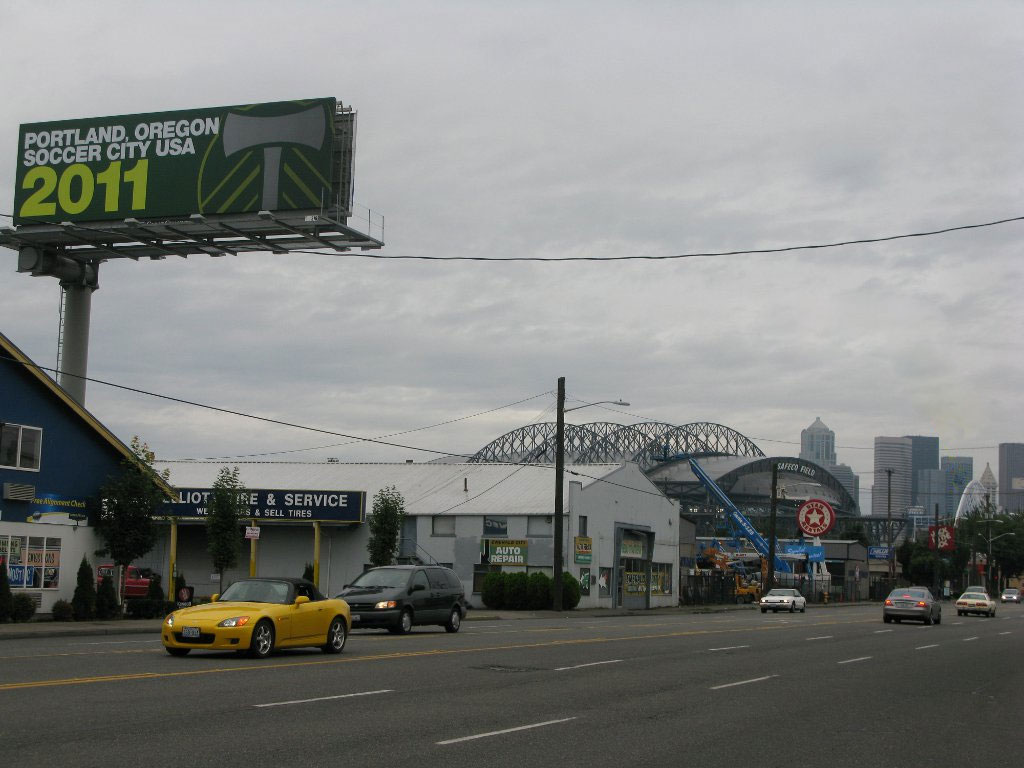
the Timbers have become a microcosmic but extraordinarily vivid expression of this urban culture, one that marks our city as a small breed apart in its own country: like the billboard says, a Soccer City.
What I’m saying here, basically, is that we have constructed a local counter-identity, using global trends.
The thing is, everyone seems to be doing it. Not long after the Timbers landed a Major League Soccer franchise, the club plastered the city’s trains with adverts with the tag line “FINALLY WE’RE ON THE WORLD’S PITCH.” The preamble was a roster of famed footballing cities: Barcelona, Milan, Liverpool, Madrid. Not, note, “Spain, Italy, England.” Consciously or not, the Timbers sought to associate themselves with cities, not countries—and to slice off a little of Barcelona’s Catalan righteousness and Liverpool’s “We’re not English / We are Scouse” bristle. Club football has become the catalyst for a specifically urban and metropolitan brand of patriotism. Inside soccer stadiums, we all think like ancient Greeks.
I have written at some length elsewhere about what you might call the “urbanization” of MLS fandom after the league’s semi-abortive ’90s effort to woo suburban soccer families. In his book A Season With Verona, Tim Parks amply documents the many ways in which Italian football serves as a hideout for the fugitive city-republic identities of that wobbly nation’s constituent parts. “VERONA: CITY AND STATE!”—it makes a cool stadium banner, but sort of crazy-sounding politics, until you consider that a major party in Italy’s governing coalition wants to unravel the country. Maybe Verona supporters are just ahead of their time. Football is the sport of cities. A fan can already squint at a world map and dissolve the national borders to see a scatter of football’s urban heat-islands glowing against a dark and formless countryside.
Portland coined its “Soccer City” nickname back in the swingin’ ’70s, when, in a fit of shag-haired whimsy, America experimented with soccer in the way it also experimented with polyamory in the same era. For a few seasons, the first incarnation of the club packed the same stadium where the reborn version plays this Thursday.
But the effort was premature; the proper civilizational conditions did not exist. Asking Americans to embrace soccer in the ’70s was like asking people to adopt a religion based on a sketch of a temple. (People in the ’70s did that sort of thing, so it worked for a while.) Plunking a “foreign” sport in a recession-prone, somewhat isolated logging town in one of the nation’s most culturally homogenous states was a little like asking the good people of today’s Des Moines to support a professional cricket team.
Now things are different. The last ten or so years have ripened the urban soccer audience—not just in Portland, but in most of metropolitan America. We have our semi-imagined Premier League allegiances, indulged on Saturday mornings; we have our long Champions League lunches. We can all tweet our minds out on our SuperPhones. Facebook avatars were essentially invented to show off hometown club scarves. It’s a niche-sized audience, maybe—but if you’re a sports franchise owner and your niche happily fills an 18,000-seat stadium about 20 times a year, you probably don’t stay up nights worrying about world domination.
In his doorstop football history The Ball is Round, David Goldblatt argues that soccer enjoyed its first wave of mass popularity thanks to displaced rural workers flocking to Industrial Age cities. Adoption of the local club—whether that meant AC Milan or Boca Juniors—provided a handy shortcut to city pride, replacing whatever age-old peasant identity had been left behind.
A post-modern version of this process unfolded in Portland during the new Timbers’ ten-year gestation in the lower divisions. Flocks of relatively unattached young people moved to Portland from all over the country and world. For a sizeable number, Timbers fandom provided a creative, malleable, loud way to become Portlanders. Passion doesn’t have to be old to run deep.
A few weeks ago, I live-interviewed author Greg Lindsay about his book Aerotropolis at a Portland book store. The book is a big ball of reportage about globalization, scaffolded by the thesis that airports have become the galvanizing feature of the modern city. One of Lindsay’s most interesting ideas is that the world’s air-linked trading cities now have more in common with each other than with their hinterlands—that Hong Kong and London enjoy a closer fraternal relationship with one another than either does with rural China or England.
Lindsay sees this same process of cultural and economic affinity playing out in the United States. He was pleased to visit Portland for the first time, he said to me, because as a resident of Brooklyn, he feels like he already sort of lives in Portland. (In the distempered aftermath of the 2004 presidential election, the writer Dan Savage hammered out the partisan version of this theory in his “urban archipelago” manifesto.) A lot of American soccer fans already live in little city-to-city confederacies of the mind. The Timbers Army and Chicago’s Section 8 have enjoyed amicable diplomatic relations since 2005. The ascension of Portland and Vancouver to join Seattle in the top flight brings the informal Cascadia Cup—a little football Hanseatic League of mutual disdain—to MLS.
I’m sure the nation-state, with its steampunky brass fittings, will be with us for some time, pro forma if nothing else. But at a time when (HA! Got it) the world’s peoples are flooding into cities, cities are lashing themselves together in fluid and ever-shifting networks of commerce and migration. The political and economic forms of the old world may not be particularly relevant to a new world in which an airport and a football ground are two essential pieces of infrastructure.
Football, the most global sport, has ironically become the vessel for the most fervent and eccentric localist impulses. In a world of unacknowledged city-states, our clubs allow us to rally to the flags that matter.
Zach Dundas is the author of The Renegade Sportsman: Drunken Runners, Bike Polo Superstars, Roller Derby Rebels, Killer Birds and Other Uncommon Thrills on the Wild Frontier of Sports, which can, and should, be bought by you, this instant.
Read More: MLS, portland timbers
by Zach Dundas · April 14, 2011
IMO this article is the perfect argument on why the New England Revolution should move from their current home (Foxboro 30-40 minute drive or more from the heart of Boston) to a more Urban location in the city of Boston. Boston is well known for its University, and just like Portland has a swell of non-Bostonians flooding in year after year, all looking for a way to become Bostonian (if only for 4 years). I more intimate and urban location for the “Revs” would surly attract more fans, and create a more communal following. Hell I’ve lived in Boston for 8 years and have never made the hike to Foxboro except for a AC Milan friendly and a few Patriots games.
This theory, should also be used for every decision in who and where an MLS team is established. Montreal I believe, one of the next clubs to join the mix will attract this exact crowd that Portland is attracting, just with a French accent and love for poutine.
@Ryan RE Montreal, it’ll just be the accent – never underestimate Portland’s passion for poutine.
@Ryan Interesting stuff mate (Zach too, lovely read), but I see Montreal as a bit of a paradox within this article’s perspective. Montrealers like myself are proud of this city, though it represents some kind of microcosm in the province. A quite significant part of the population of the Island of Montreal speaks mostly English (sometimes exclusively) while Quebec is officially a francophone province. As a matter of fact, French is my first language (though poutine is not necessarily my first choice of meal) and I could not be prouder of this. This being said, the Montreal Impact, due to join MLS in 2012, currently boasts a French (as in from France) Connection which makes me think that the club will try to capitalize on what makes the province, not really the city, unique in the MLS context: Montreal will be the only club in MLS where the supporters speak French in their everyday lives, and the club has already adopted a somewhat Province-of-Quebec-oriented image (fleur-de-lys like logo, blue and white team colors, etc.). Our province looks like a franco island in an anglo ocean, but Montreal is quite different from the other regions of Quebec. I am absolutely positive that the Impact’s support in MLS will be massive. I’m just not really sure it relates to Portland’s support that much.
In any case, Montrealers are already proud of their team, will keep on supporting it and will unite under one leitmotiv: massive Toronto FC-loathing.
@OliTremblay Thanks for the comment, and in fact I think that’s part of the point—the game is globally uniform to the point of being generic, but each local fandom expresses a completely different identity.
@Richard True. We just love food. I thought the funniest Portlandia sketches were those about food. Someone needs to do a sketch off of the actual Portlandia, though.
I’m a bit of an opposite case. I grew up in Portland and have gone to number of games over the years (a couple of years ago the Timbers hosted Seattle in the Open Cup and I couldn’t tickets so I stood at the fence that ran along one of the bylines for the whole game. The whole fence was crowded with people) and now I’m in the Midwest, so to celebrate the home opener I’m going to have to go to a bar with scarves in tow.
@Zach Dundas Cheers for the reply. I have to agree with you; it’s funny how a game with such a global reach translates into a very, very specific subculture on the local scene. Maybe that’s why football became more important to me than ice hockey over the years. As much as I love the Montreal Canadiens, I’ll probably never feel as strong an “us vs. them” sentiment during a Canadiens game than when the Impact faced Santos Laguna of Mexico. Footy in North America might follow most of the same rules and standards as other sports, but the global scope of the game leads to soccer clubs being much more representative of the local community than in baseball or ice hockey for example. That’s how I see it, anyway. In the NHL, for example, there isn’t much difference between the Leafs and the Senators, but I’d get my ass kicked if I said the same of Chivas USA and the Galaxy…
@OliTremblay Yes, the Chivas fan would certainly take exception.
Great piece, I very much liked all that talk of city-states, though I intially scoffed (in a manner scarily reminiscent of my father, indeed) when I saw that line about airports.
I couldn’t help thinking, though, that football is less about cities than it is about neighbourhoods or barrios. Even in the small city where I live, Mar del Plata (Arg), the city is divided down the middle between two utterly useless teams, Aldosivi and Alvarado. The former are in the second tier, the latter in the fourth. We hate the puto Aldosivi ‘gringos’ from the port and they hate us, probably for similar enough reasons. While in cities like Baires or London there are teams in every neighbourhood, sometimes more than one.
Although money and god gives a bollocks what else may have bolstered the Madrid-Barca rivalry into the money-monster it now is, I imagine that on a daily basis even in those cities it says more about who you are whether you follow Real or Atlético, or Barca or Espanyol, as the case may be.
Of course, these are places where time has allowed the opening of wounds and the scabbing of the same; resentments have had time to fester into soupy bile encrusted with tradition to be mined by tv companies. One can hardly ask that of Portland so soon. Still, the day friends squabble and fall out over a controversial handball, families are torn in two by a contentious derby and hospital staff brace themselves for the final whistle, that day, my friends, MLS will have grown up.
Or do Americans tend to like their sport on a more city-v-city basis? In which case, please disregard the above.
@Danny Thanks for the fantastic response. Obviously, there are places where intra-city rivalries dominate, and express a different kind of urban identity. In the US, city-to-city rivalries are more common and traditional, because only the very largest cities (New York, Los Angeles, Chicago) have usually been able to support more than one “franchise” that operates on the continental scale US leagues demand.
@OliTremblay My perspective as a Southern U.S. hockey fan leads me to think the subcultural appeal of soccer in the U.S. and Canadian cities might not be so much soccer-specific as a characteristic of historically-niche sports versus the dominant sport of their region (hockey for you, American football or college basketball for me as a Virginia-resident fan of the Carolina Hurricanes).
In the European and Latin American club context, a club’s representation of a subculture within the larger city or region is built on its roots in a specific neighborhood, as @Danny pointed out. Soccer-fan subcultures north of the Rio Grande and hockey-fan subcultures in the Sun Belt aren’t like that; they look to me much more like intentional communities that both fans and the club have realized must form lest the team wither and die.
A key trope of these intentional communities seems to be caricatured expressions of regional identity — chainsaws in Portland, whole-pig barbecues outside the RBC Center in Raleigh before going in to watch the Canes. But to equate pride in that caricature with representativeness is a step too far — these subcultures are still *sub*. The Barra Brava and Screaming Eagles may wave District of Columbia flags, but it’s hard to argue that they’re more representative of the city or the Washington region than Redskins fans who are numerically stronger by a couple of orders of magnitude (even as the ‘Skins practice in Virginia and play in Maryland). They’re just louder about their D.C.-ness. Fans of the dominant sport don’t have to so vocally claim their city — they have it, and they know it.
@JoshC I come hear to read about the impressive (but unmistakably nerdy) Timbers fans I’m watching debut on ESPN2, and I run into another Canes fan? Awesome.
Nice work Zach.
@Danny
We have that in Chicago but in baseball. Theres still people that I lost all respect for because they switched teams when the white sox were in the world series, I haven’t talked to them about sports since. Turncoat benedict arnold bastards.
@Ryan Heartily agree Ryan. I rabidly supported football in that area (2 hrs from Boston) for years. The Revs were the highest level of football associated with my area, and yet I only attended 2 of their matches, and one was solely because it was directly followed by a USMNT WC qualifier. It never felt like football, supporting them, watching them. It felt wrong in the enormity of Gillete. It felt like Big America was letting a few weirdos enjoy their odd past time. The lower reaches of the stadium barely filled. It was what it would be like if a baseball game was played at the San Siro. This New England football was completely different from the football I followed in Old England, and it made me feel awful. This Portland phenomenon is certainly special.
@MC07 ugg my stupid websense totally f’d up a long but intelligent post (i swear) i had agreeing with you and things that could be done, but alas it got choked into my companies websense black hole. ah well, live and learn, copying my response before posting will be my new habit hear at ROP.
And what a game it was last night!
I do kind of wonder, then, if cities that already offer a number of other ‘easy outlets’ for identification will be the last MLS places to have particularly strong supporters’ groups or team culture.
I’m a Bostonian, and while I agree with Ryan above (mostly because it’s damn near impossible to get out to Gillette Stadium without a car), I wonder if the proliferation of things like universities, with their own cultures and identities that are easily graspable will prevent people from using their local club to do the same thing.
Great article. I live in Houston, home of the Dynamo, and I’ve definitely witnessed some of the ” identification through a club” idea discussed in this article and in the comments. Probably about a third of Houston’s population is Hispanic/Latino, and if I had to guess, I’d say that about 70% of people attending the Dynamo games are Hispanic/Latino.
In Houston we have a few other major sports franchises (Texans, Astros, Rockets) of which Dynamo is the least popular, but the fans of the Dynamo are some of the most passionate in the MLS. The Hispanic community here supports the sport that they love (soccer) in a city they are proud to live in (Houston). Many of the chants are in Spanish (“Dale, dale, dale Dynamo!”) and some have been taken straight out of the Mexican soccer culture (“oooooooOOOOOOH-PUTO!” – on goal kicks) so that it barely feels like you’re still in the US. I believe this is more of the identification of a specific neighborhood/community/part of the city, than it is of the entire city as discussed in the article. Though the Dynamo been doing rather poorly lately, the Houston city council has taken notice of the fans, and construction of the new stadium should be completed sometime soon. Just in time for when I move to Portland for college…
@Zach Dundas Even in the cities with multiple (say) baseball teams, they tend to be in different leagues from each other, so that Angels-Dodgers or Yankees-Mets rivalries are on a more philosophical level — a support of AL or NL, for example. Because they are in different leagues, they almost never end up playing each other, at least not in games that matter. Far more real and visceral are Giants – Dodgers, or Yankees – Red Sox, games that conjure up far more of the vitriol and town patriotism that you see in soccer. There’s no Tottenham-Arsenal-esque rivalry in New York, and therefore no New York Derby, because the two teams there don’t regularly compete against each other outside of “friendlies”.
College sports are another matter entirely. While Stanford and Cal are within the same greater urban mass of the San Francisco Bay Area (and about as far from each other as the Giants and A’s, or 49ers and Raiders), there is considerably more rivalry between the two college teams than there is between the geographically analogous pro teams — and don’t even get me started about U$C and UCLA.
@Eben LaPier
Except that the two New York baseball teams do play each other in regular season games (six times a year, actually), and it is actually a big deal. It’s not Tottenham/Arsenal, sure (mainly because the Yankees don’t regard the Mets as much of a threat), but it’s up there in intensity with Liverpool/Everton or Man U/Man City.
http://www.youtube.com/watch?v=s50SvZm9jQE
Not for anything to do with Portland, but I am thoroughly enjoying the MLS culture in Philadelphia. I’m coming into the game as a fan through the Union, and PPL Park is pretty much the best place I could imagine. Portland might be, I don’t know, too intense.